Independent mathematics research
The same structure keeps
returning, wearing different names.
Avadari studies the parallels that surface again and again across algebraic, differential, and advanced mathematics — the recurring architecture behind Euler's identities, the zeta function, and the machinery that connects them. We think these aren't three subjects. They're one grammar, spoken in three dialects.
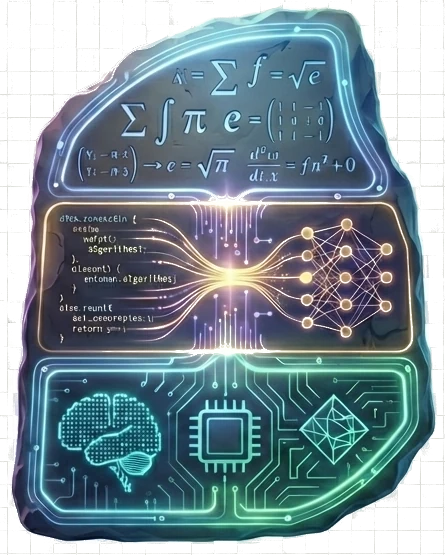
The Avadari Method
Three threads, one grammar
At Avadari, we work quietly, test results against a small circle of collaborators before they leave the building, and publish only when a proof is load-bearing — when it holds weight for more than one field at once.
The working hypothesis underneath everything here: algebraic identity, differential behavior, and the deeper machinery of primes and zeta functions are not separate territories that occasionally intersect. They are the same underlying shape, observed from three different instruments.
A working analogy
Three scripts, one slab, one decree — that's the whole idea.
In 1799, a single decree was carved into the Rosetta Stone three times: once in hieroglyphic, once in Demotic, once in Greek. Not three different messages — one message, in three notations. Once scholars could read the Greek, the stone became a machine for teaching them the other two.
The Avadari Method treats algebraic, differential, and advanced mathematics the same way: three notations for one underlying text. A result that's stubborn in one language often turns out to already be solved in another — we just have not learned to read the translation yet. Finding the inscription that survives the trip from one script to the next, and using it to carry a proof across, is the method itself.
Structure & symmetry
Where identity is exact. We look at what a relation preserves when everything around it is allowed to change — the invariants that survive transformation.
Change & flow
Where identity is a rate. The same structures reappear as behavior over time — as the rule a system obeys while it's in motion, not just at rest.
ζ, primes & Euler
Where the two meet. The zeta function and its relatives sit at the seam — analytic objects that encode strictly algebraic information about primes.
Publications
Papers & proofs
The Geometric-Algebraic Structure of the Partitioned Riemann Zeta Function
We present a geometric-algebraic partitioning of the Riemann zeta function to consider a previously unreported structural relationship between its symmetric components. A geometric interpretation of beta(n) and eta(n) is offered, exposing a coordinate ratio K(n) with a remainder k(n) that links discrete and known transcendental values of zeta(n).
Get in touch